Provided through the courtesy of M. David Mullen, A.S.C.
ALTHOUGH the wide-film experiments of a year ago proved
themselves only experiments, they have had at least one
result of lasting importance in that they focused the
attention of the industry on the unsatisfactory conditions
existing as a result of the absence of a true standard for
sound-film picture apertures. Therefore although wide film is in
itself a forgotten issue, it benefited the industry by starting the
researches conducted by the American Society of Cinematographers,
the Academy of Motion Picture Arts and Sciences,
and by the various producers and manufacturers, which have
resulted in the recommendation of a new standard of camera
and projection apertures, which are already adopted by some
producers, and are expected to soon become an industry-wide
standard.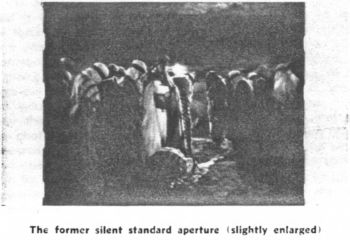
From the earliest days of the moving picture up to the
advent of the movietone, the standard frame dimensions were
.6795" x .906", giving a rectangular picture with a proportion
of 3 x 4. This proportion, although determined and standardized
largely by accident, has proven to be the most satisfactory
one from both the artistic and psychological viewpoints.
It is satisfactory for more than 90% of all possible compositions,
and moreover probably the most restful proportion to
watch for the length of time necessitated by the average feature
picture. in a word, though it may not represent the absolute
ideal proportion of the artistic purist, it is sufficiently close
thereto to be considered ideal for all practical purposes.
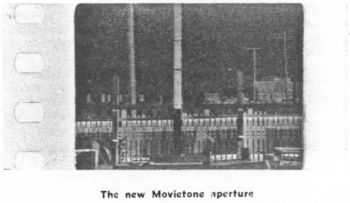
The advent of the talking picture, however, necessitated an
alteration of this proportion in order to accommodate the sound
track, which arbitrarily sliced .l" from the left-hand side of
the picture, leaving a practically square frame. This is an
unsatisfactory proportion from every viewpoint. It is an almost
impossible frame for the cameraman's efforts at composition,
and a most unpleasant proportion for the audience which must
concentrate upon it for an hour or more. Such a state of affairs
could certainly not be allowed to exist; therefore several theatre
chains and some producers as well, independently adopted
reduced apertures which restored the old 3 x 4 rectangle. Unfortunately,
however, not all of them did so, while the producers using
disc recording, and the theatres equipped only
with disc reproducers naturally enough continued to use the old,
silent-standard full-frame aperture.
 Therefore picture-makers were faced with the necessity for
planning their pictures to be suitable to several projection
apertures: the old full-frame silent and disc standard, the
movietone square, and the several reduced 3 x 4 movietone
apertures. Every phase of production and exhibition suffered
from this chaotic condition, and photography, naturally, more
than any other. For even if a studio and the theatres controlled
by its owners had standardized on one of these formats, the
cameraman was forced to allow for all of the others in his
compositions. Otherwise, when his pictures played the smaller
houses, or the larger ones controlled by other interests. his
scenes would be in danger of misframing-of having heads or
feet cut off, or, if a larger aperture was used, of having his
carefully planned compositions destroyed by the larger frame.
Inevitably the quality of the photography suffered, and with
it projection, sound, direction, and all of the other things that
depend to any extent upon the work of the cameraman.
Therefore picture-makers were faced with the necessity for
planning their pictures to be suitable to several projection
apertures: the old full-frame silent and disc standard, the
movietone square, and the several reduced 3 x 4 movietone
apertures. Every phase of production and exhibition suffered
from this chaotic condition, and photography, naturally, more
than any other. For even if a studio and the theatres controlled
by its owners had standardized on one of these formats, the
cameraman was forced to allow for all of the others in his
compositions. Otherwise, when his pictures played the smaller
houses, or the larger ones controlled by other interests. his
scenes would be in danger of misframing-of having heads or
feet cut off, or, if a larger aperture was used, of having his
carefully planned compositions destroyed by the larger frame.
Inevitably the quality of the photography suffered, and with
it projection, sound, direction, and all of the other things that
depend to any extent upon the work of the cameraman.
At this time, as a strictly temporary measure, the Academy
recommended that all vital action be kept within a three by
four rectangle marked on the camera ground-glasses, and made
so as to suit as nearly as possible the various reduced apertures
being used in the theatres. This was very helpful, but
only as a makeshift, for the cameramen have had to fill about
twenty per cent of their frame area with non-vital action or
unessential views of the set.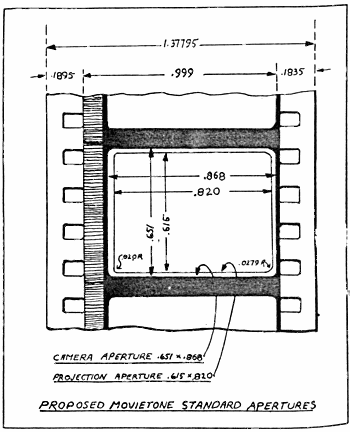
To rectify this condition, the A.S.C., the Academy, and
the various other interested groups have cooperated in devising
a new aperture. This new aperture restores the
desirable 3 x 4 rectangle, and is to be used for all purposes
including the now rare disc and silent versions. As the diagram
shows, it provides for a projection aperture slightly smaller
than the camera-aperture. The dimensions of the photographing
aperture are .651" x .868". The dimensions of the projection
aperture are .615" x .820". These standards have been
officially recommended by the various agencies involved in
their development, and will soon have been standardized by
all of the major producing and exhibiting firms, which will,
naturally, compel the smaller independents in both fields to
follow suit. Although the new standard has been announced
only a short time, it has already been adopted by the Metro-
Goldwyn-Mayer studio and is in use on all of the productions
now in work at that plant. The Paramount Studio is also
adopting the new aperture, and a majority of the other major
firms are either preparing to make a similar change or seriously
considering doing so. A full report of the proposal has been
forwarded to all studio executives by Lester Cowan, Executive
Secretary of the Academy. The studios have been asked to
make their decision by November first. The proposal will
next be referred to the principal theatre chains, and thereafter
a definite date will be set after which all productions will be
photographed with the new aperture.
Its adoption will be of far reaching benefit. The first to
feel it will naturally be the cameramen, who will no longer
be forced to compose simultaneously for a variety of apertures
and proportions. The other production departments will, in
consequence, be benefited. The design, construction, and
lighting of sets will be vastly simplified. The tops of large
sets can be lowered by as much as five feet, and all sets can
be reduced in width by nearly ten per cent without making
any change in the placing of the essential action and props
as photographed for the past year. Scaffold lights can be
lowered from three to five feet, thus making possible either a
reduction in wattage or the use of fewer units. Microphones
can be lowered from three to five feet, resulting in an obvious
advantage in sound quality and convenience for the sound
department.
The studios will be assured that their pictures will be projected
exactly as photographed. The exhibitors will be able to
standardize their projection equipment with the assurance that
they will be able to play the product of any producer without
danger of bad projection due to misframing and conflicting
apertures. And the public will get the best visual quality that
the producers and exhibitors can give it, combined with the
soothing psychological effects of the easy-to-look-at 3 x 4
rectangular picture. In a word, we have taken another step
in our return to the photographic normal.