The Inheritor
 
The year 1959 saw the release of films in three
70mm competitors to Todd-AO. In addition to Super Technirama 70 and MGM
Camera 65/Ultra Panavision, an out and out duplicate of the Todd-AO system
was introduced by Panavision, Inc. Ultimately the process was named Super
Panavision 70, but it was also referred to as Panavision 70, Super Panavision,
Panavision, Photographic Process by Panavision, and Panavision Super 70.
The success of Super Panavision 70 was not due to an inherent superiority over Todd-AO. Success came in the form of the business models chosen by Panavision and Todd-AO. Panavision merely rented and maintained the equipment while Todd-AO charged a royalty on every ticket sold in the 70mm roadshow presentations. They received nothing from the optical printdowns to 35mm. Panavision grew in popularity among independent producers as well as the large studios because of their quality, innovation, and accommodation for their customers.
In 1959, Walt Disney had the distinction of releasing the first films in
both Super Technirama 70 (Sleeping Beauty) and
Super Panavision 70 (the independently produced The Big
Fisherman).
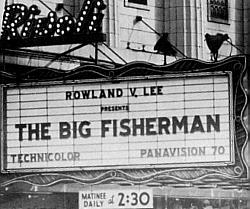
The
Big Fisherman roadshowed in 70mm in 47 cities, seen above in Todd-AO's New York home, the Rivoli Theatre, but it was a very brief run in comparison with other roadshow engagements. It must be remembered, however, that Super Panavision came out of the development
of the M-G-M Camera 65/Ultra Panavision 70 project and these systems were
originally intended to be used, for the most part, to produce extremely
high quality 35mm reduction general release prints. Like VistaVision, the
concept was to use a large negative to produce a vastly superior 35mm print.
This concept is lost to film makers today.
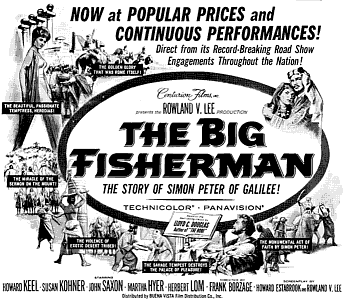
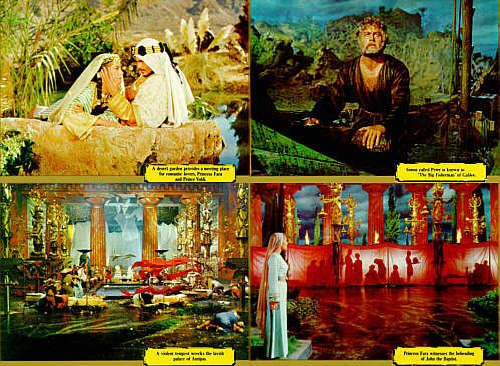
Illustrations courtesy of Robert Cioffi
Above, a newspaper ad for the general release of The Big Fisherman touting that it was direct from its record breaking roadshow run. Record breaking, indeed! It might have been the shortest, most secret roadshow run ever. But it did get run in Panavision 70 or whatever name they put on it. The film received favorable reviews from The Legion of Decency, The Christian Science Monitor, and similar religious bodies but other reviewers were not very kind. Seen below the ad are a series of colorful stills. Even seen full size, they aren't much more enticing than the small copies shown here. Reports state that this film is undergoing "restoration" at Disney at this time. The reports don't explain why. The curator saw this film in 1959 and can only recall that Howard Keel had big hair, which was beautifully photographed.
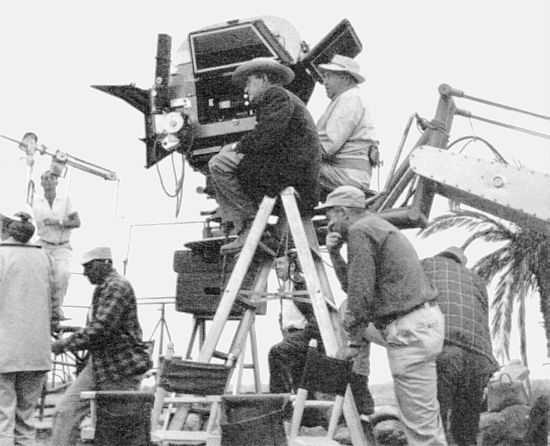 At right is a production still from The Big Fisherman showing the 65mm Mitchell built Panavision camera in its aluminum blimp designed by the iconic Takuo Miyagashima (1928-2011). The camera had been set up for MGM Camera 65 and the viewfinder was marked for the ultra wide Ultra Panavision frame, but the crew seemed to manage pretty successfully in recording the 20% narrower Super Panavision frame. At right is a production still from The Big Fisherman showing the 65mm Mitchell built Panavision camera in its aluminum blimp designed by the iconic Takuo Miyagashima (1928-2011). The camera had been set up for MGM Camera 65 and the viewfinder was marked for the ultra wide Ultra Panavision frame, but the crew seemed to manage pretty successfully in recording the 20% narrower Super Panavision frame.
 "Tak" Miyagashima beams when presented with the Oscar. According to the Academy "This Oscar is presented to an individual in the motion picture industry whose technological contributions have brought credit to the industry." Tak was the recipient of numerous awards of appreciation. The list is too long to include here. "Tak" Miyagashima beams when presented with the Oscar. According to the Academy "This Oscar is presented to an individual in the motion picture industry whose technological contributions have brought credit to the industry." Tak was the recipient of numerous awards of appreciation. The list is too long to include here.
One thing that marks Tak as very unusual for a man who was a fountain of knowledge is the fact that he had no reluctance to saying, "I don't know". There are so many experts who don't skip a heartbeat in providing an answer to a question for which they had no answer. How refreshing Tak was.
Film Frames From The Big Fisherman
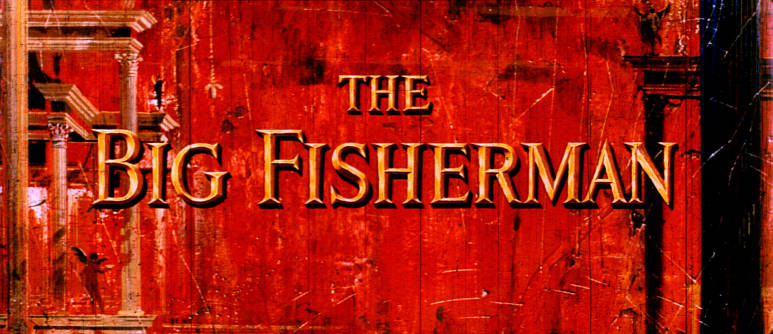
While The Big Fisherman may not have been the best epic ever made, it surely was an attempt to create a classy presentation.
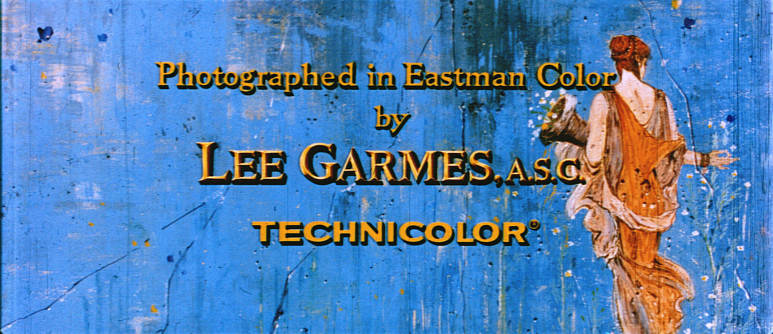
This is a somewhat unique film credit. Typically only a "Technicolor" or "Color by Technicolor" credit appeared. Eastman Kodak was not pushy about receiving screen credit just as long as the producer bought lots of very expensive film. Veteran cinematographer Lee Garmes, ASC was responsible for the credit. He must have been very happy with Kodak.

Up to this point the only 65mm productions using Panavision cameras and lenses had been the anamorphic MGM Camera 65. While the Curator has always thought that MGM's name for the system was very much lacking in imagination, at least it was a name. For The Big Fisherman, filmed with the same cameras but using spherical lenses, Panavision seemed to go into a brain cramp. In some of their publicity, Panavision referred to the system as Panavision 65, and that could be either the anamorphic or spherical version. Print ads for The Big Fisherman most usually carried a credit simply saying "Panavision". Where 70mm prints were run the ads stated "Panavision 70". The next two films, Exodus and West Side Story carried credits saying "Panavision 70", though Saul Bass used a "Super Panavision 70" credit in his poster art. With Lawrence of Arabia the "Super Panavision 70" moniker stuck.
Thanks to Richard Ducar and Peter Apruzzese for scans from a 35mm Technicolor anamorphic print.
You are on Page 1 of 
  
©1996 - 2004 The American WideScreen Museum
http://www.widescreenmuseum.com
Martin Hart, Curator |