VistaVision's Aspect Ratio
Let's Kill The Fallacy
You can read all over the Internet, in magazines, and even on the backs of DVD cases that VistaVision's aspect ratio was 1.66:1. Well, it ain't so.
Prior to the introduction of VistaVision, Paramount Pictures promoted the 1.66:1 aspect ratio as THE ideal shape for movies. But when VistaVision came into being they quickly changed their tune and strongly supported a ratio of 1.85:1. Their framing guide, (see bottom of this page), made provision for showing films at 1.66:1, 1.85:1 and 2:1. For struggling theatres Paramount felt that they could use 1.66:1 and not need to spend a huge amount of money installing a new screen and having major achitectural changes to their prosceniums. For theatres that had put in big screens for CinemaScope, Paramount felt that the Technicolor print could hold up to being cropped to an aspect ratio of 2:1, though it was not a recommendation. It was good old 1.85:1, the same shape that the other studios were quickly adopting for their cropped wide screen films that Paramount recommended for VistaVision. And compared to your run of the mill cropped wide screen image, VistaVision just blew them away.
In Europe, where 1.66:1 was a much more commonly used ratio for cropped wide screen, VistaVision was still recommended to be shown at 1.85:1. The Rank Organisation, the Eastern hemisphere's promoter of VV, even developed an anamorphic print that had a 1.85:1 ratio.
So don't go believing the junk on the back of those DVD boxes.
|
  
Many upgraded photos have been added to this section.
Read the complete text of the VistaVision article written by your Curator for
WideGauge Film and Video Monthly |
Paramount Pictures was the only major studio
in the U.S. that didn't immediately embrace CinemaScope for use on its major
productions. The studio preferred to stick with an aspect ratio of 1.66:1
but sought ways to improve overall picture clarity and definition on ever
increasing screen sizes. John R. Bishop, head of Paramount's camera and
film processing departments acquired a William Fox "Natural Color"
camera built in the late 1920's by the William P. Stein company. This camera
exposed two frames of film at the same time through color filters. Bishop
cut out the separation between the two frames, rolled the camera over on
its side and fitted it with Leica 35mm still camera lenses. This camera,
dubbed the "Lazy-8" because it pulled the film across horizontally
in 8 perforation frames, provided a total negative area 2.66 times greater
than the conventional 35mm camera with a 1.66:1 aspect ratio.
Paramount technicians, working with Eastman Kodak, determined that the large
format negative, when printed down to standard 35mm provided a vastly improved
image on screens up to 50 feet wide. A second "Natural Color"
camera was obtained and converted. Armed with two Lazy-8 cameras, Paramount
went to work filming White Christmas in late
1953, while ordering radically new cameras from the Mitchell Camera Company.
While Paramount waited for improved VistaVision cameras, the Lazy 8, in its distinctive red rubber sound blimp, was used to film not only White Christmas, but also We're No Angels, Run For Cover and a number of travelogue short subjects that showed off VistaVision's high quality image.
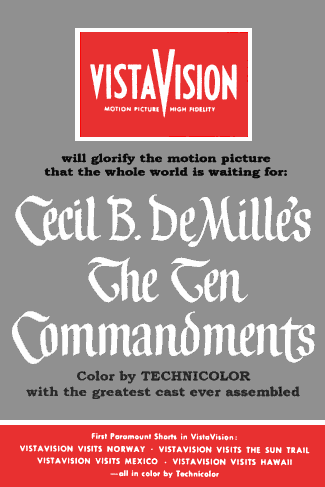
Seen above right is a Paramount trade paper ad promoting
VistaVision. Though over a year would pass from the introduction of VistaVision
until the release of The Ten Commandments it
was that film that had been earmarked as the showcase for the high resolution
process. Note that, like other processes of the time, featurettes showing
off the new technology abounded. Paramount had been an early advocate of
Technicolor. This close relationship lasted for decades. While a few VistaVision
films were done in black & white, the process specifications virtually demanded
processing and printing by Technicolor. Much of VistaVision's image quality
must be credited to the Technicolor imbibition (dye transfer) printing process.
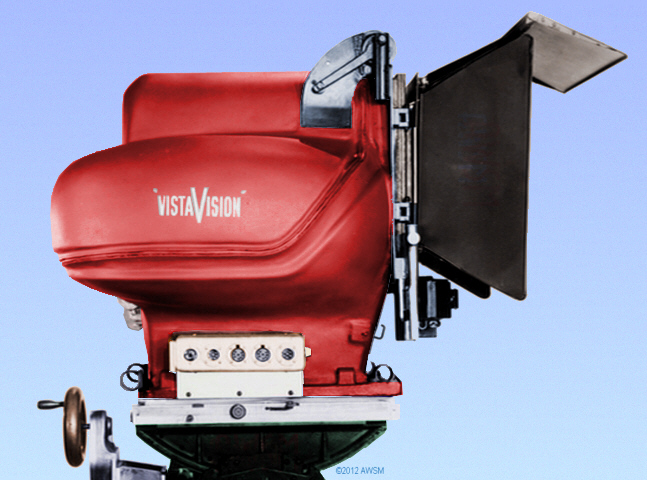 Seen at left is one of the two Stein "Fox Color" cameras that Paramount engineers adapted for the horizontal 8-perforation film format. Seen at left is one of the two Stein "Fox Color" cameras that Paramount engineers adapted for the horizontal 8-perforation film format.
Below are more "Lazy 8" production stills.
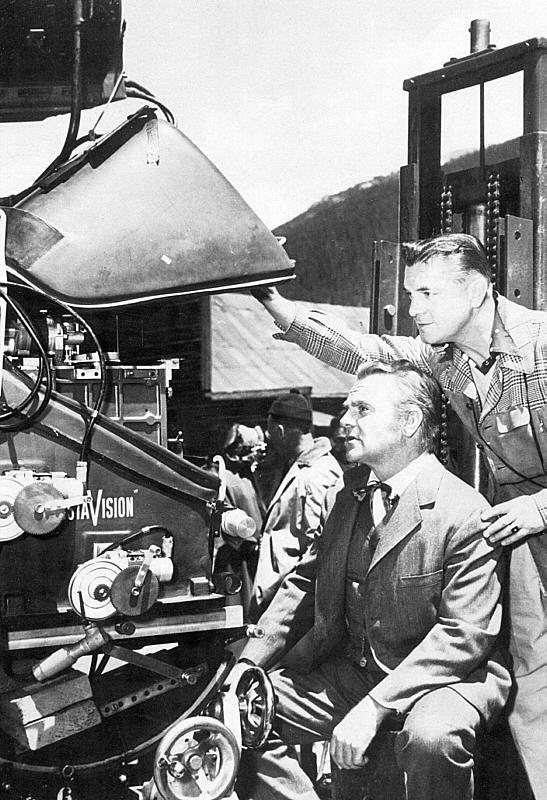 At left is actor James Cagney and camera operator Haskell Boggs inspecting the Lazy 8 camera during the filming of Run For Cover in 1955. Boggs was shortly to become a director of photography with a long distinguished list of films to his credit. At left is actor James Cagney and camera operator Haskell Boggs inspecting the Lazy 8 camera during the filming of Run For Cover in 1955. Boggs was shortly to become a director of photography with a long distinguished list of films to his credit.
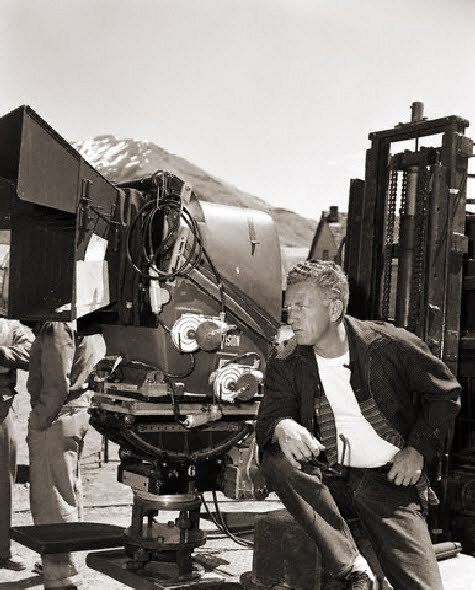
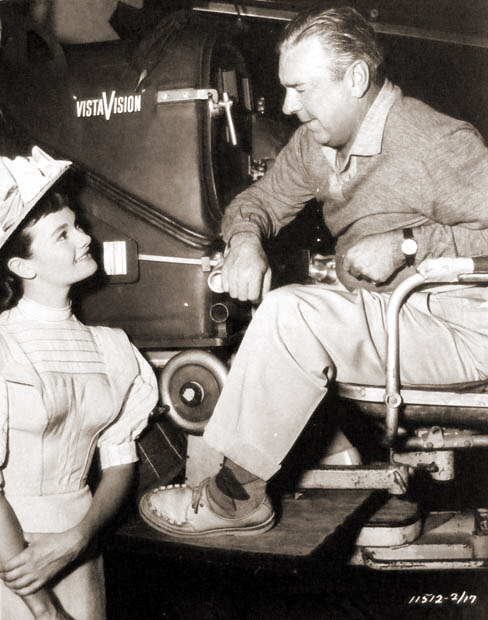
Below left is Run For Cover director Nicholas Ray seated behind the same camera during production. Below right is actress Gloria Talbot and director of photography Loyal Griggs, A.S.C. schmoozing by the Lazy 8 during the production of We're No Angels, which starred Humphrey Bogart, Peter Ustinov, and Aldo Ray.
 |  |
A Personal Message from Adolph Zukor
It has always been our policy that pictures should be capable of being played in any theater in the world. Therefore, we recommend standard sprocket-hole film and standard position, single, optical sound track. To improve the exhibition of pictures, we do feel that screens should be as high and as wide as the theater can install.
A year ago last May we released SHANE as the first of the widescreen pictures from Paramount and have since perfected the VistaVision process to still further improve the definition and quality of picture. The first of the VistaVision pictures to go into release will be WHITE CHRISTMAS, to be released in October. Perspecta sound has been added to VistaVision prints and may be used, if desired, by any theater which has the proper equipment.
With regard to the shape of pictures on the screen, we are convinced that the most artistic shape is in a ratio of approximately 1.85:1, and we also find that this shape best fits the great majority of theatres. In the future we are confident that the best in the presentation of motion pictures will be obtained with VistaVision prints shown on a high, wide, seamless screen of this shape, and using excellent projection equipment.
ADOLPH ZUKOR
Chairman of the Board,
Paramount Pictures Corp.
|
Published in the September, 1954 issue of International Projectionist, which featured many items relating to the first anniversary of the introduction of competitor 20th Century-Fox's CinemaScope system.
(courtesy of David Johnson)
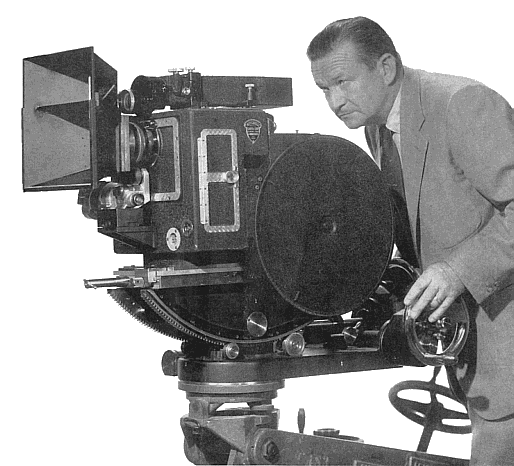
John R. Bishop posing with the newly developed Mitchell Elephant
Ear VistaVision camera. In setting goals for the development of the
new camera, Paramount had requested that the camera would be silent, if
possible. The Elephant Ear turned out to be one of the quietest cameras Mitchell produced up to that time. Still, for dialog recording, the camera would require a massive blimp.
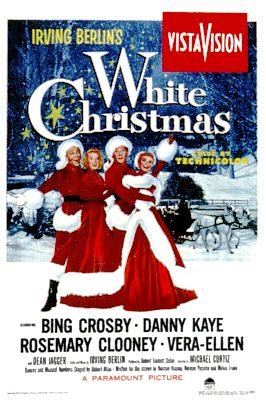 | Left: First film out of the chutes for VistaVision, White Christmas wasn't the blockbuster that Fox's The Robe was, and VistaVision didn't inspire other studios to use the process the way CinemaScope did. But the song sold about a zillion copies and is still a record holder, no pun intended.
Right: A rather inauspicious second feature produced in VistaVision, the Martin and Lewis film, Three Ring Circus | 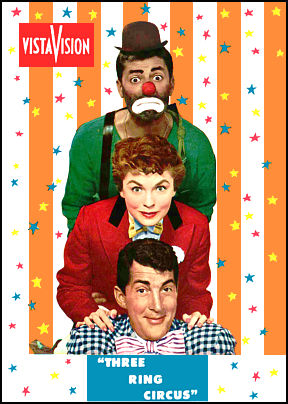
Courtesy of Robert Weisgerber |
Lobby Card for White Christmas
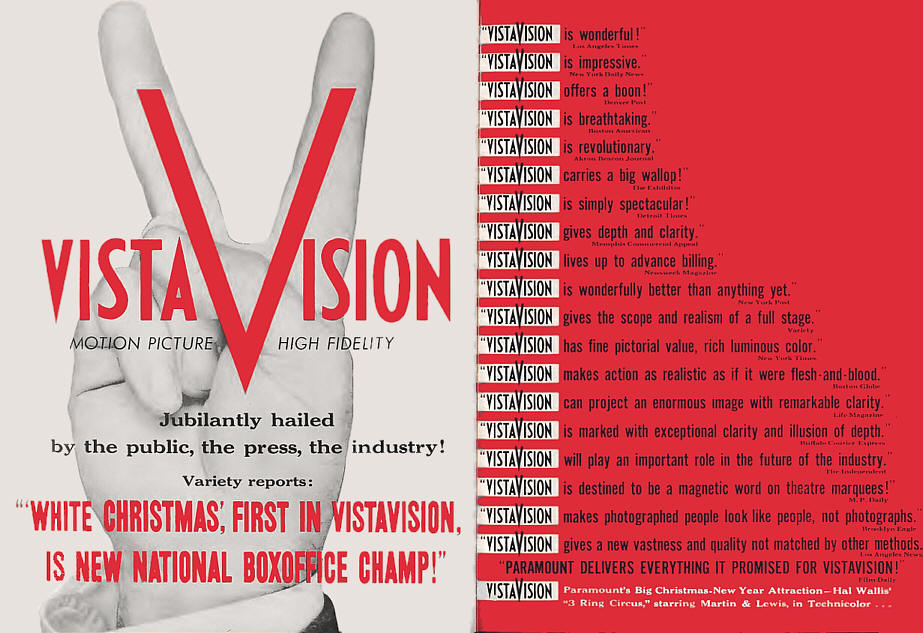
Apparently Winston Churchill thought highly of VistaVision
Trade Ad courtesy of Stephen Paley
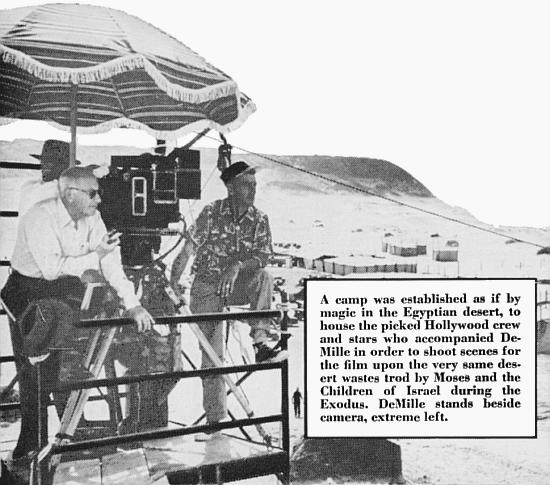 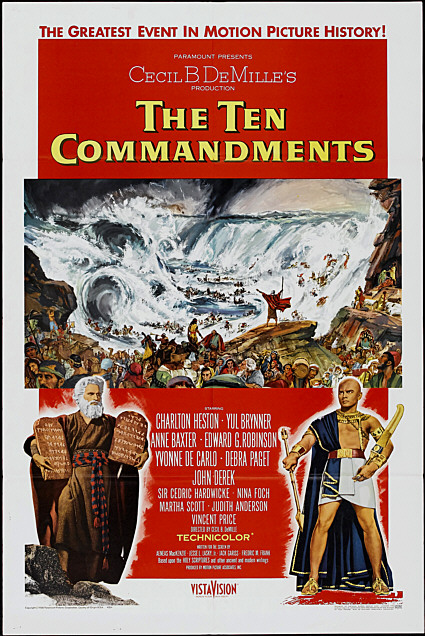
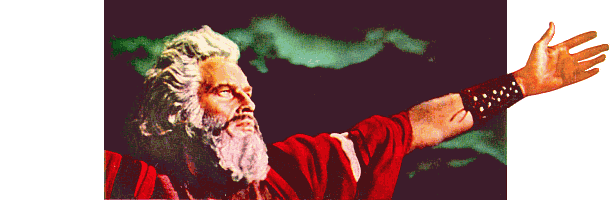
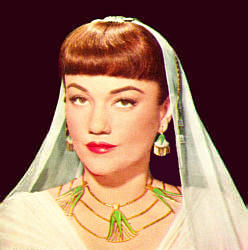
The Paramount publicity department was as boastful, and full of baloney, about the making of The Ten Commandments as they were about VistaVision. The only stars that made the trek to Egypt were Charlton Heston, and Yul Brynner (very briefly). Other than a couple of miles of footage of Heston stumbling around in the wilderness and segments shot on the California beach for the Exodus segment, the film was shot entirely on the Paramount sound stages and it's painfully obvious.
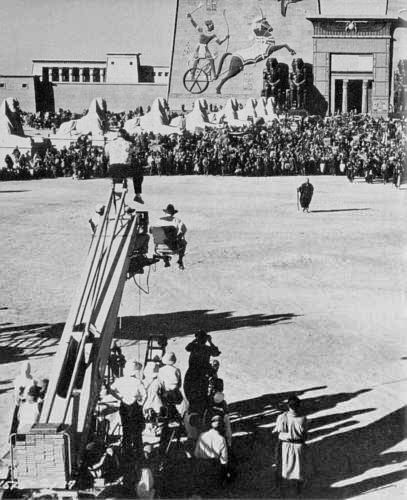 Okay, everybody say, "cheese"! Okay, everybody say, "cheese"!
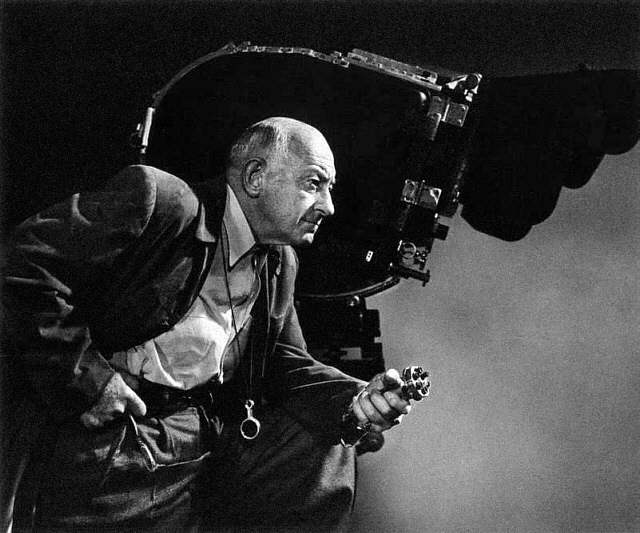 
Cecil B. DeMille, ever the showman, poses heroically with the VistaVision camera. If the pose looks familiar it may be reminding you of Henry Wilcoxon, who stood that way in dozens of deMille films. Hell, Everybody stood that way in a DeMille film.
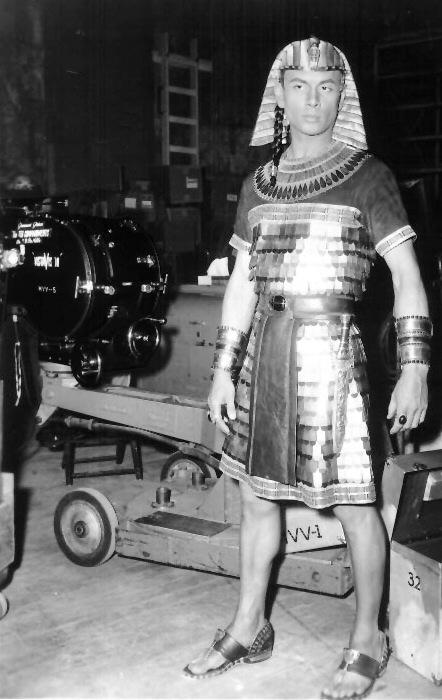
At right, Yul Brynner seems to be able to strut while standing still. Here we find him testing a new costume. Brynner won his Oscar for The King and I but he was a natural in the role of Rameses II in The Ten Commandments. |
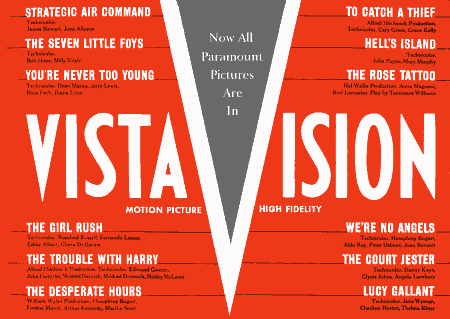
While Cecil B. DeMille was working on The Ten Commandments, Paramount put all their resources into VistaVision. This is a two page trade journal ad listing some of the first VistaVision features planned. The studio also released Technicolor short subjects showing scenes from all the VistaVision films that were in production. It's somewhat interesting to note that production on The Ten Commandments took so long that Charlton Heston made two VistaVision films for Paramount during the time he was also playing Moses. illustration courtesy of Stephen Paley

What's This?
You are on Page 1 of 
     
©1996 - 2004 The American WideScreen Museum
http://www.widescreenmuseum.com
Martin Hart, Curator |